 Pastri
How to calculate the price of a cake
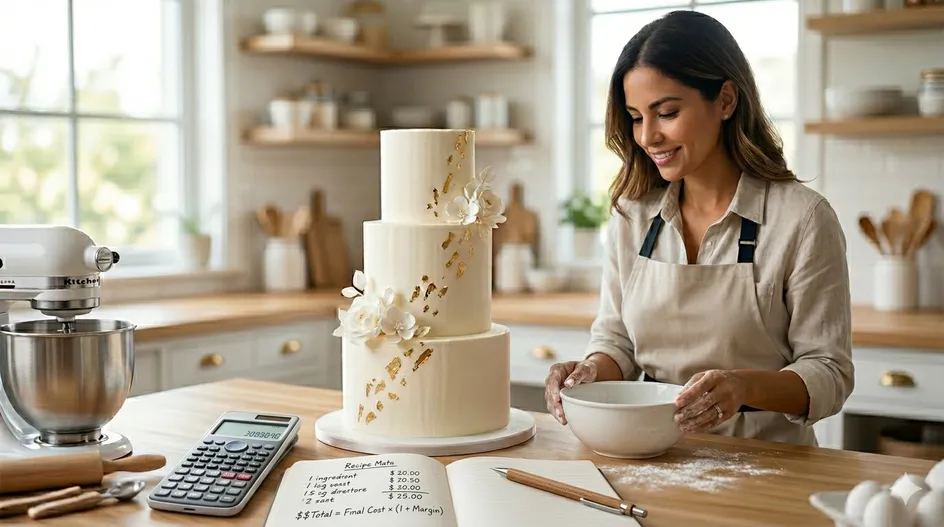
One of the most rewarding moments for any baker is when someone outside their family circle says, “I loved your work! How much do you charge for a cake?”. In that split second, a hobby transforms into a potential business. However, that is also the exact moment when the biggest headaches begin. How much should you charge? How do you know if you are actually making money or just breaking even?
The most common and destructive mistake in home baking is pricing “by eye,” basing rates on what the competitor down the street charges, or applying the famous but outdated rule of “multiply your ingredient costs by three”. If you are still using this method, chances are you are subsidizing your clients’ events and losing money without even realizing it.
To build a healthy, sustainable baking business that allows you to grow, you need to understand the true anatomy of costs. Below, we break down step-by-step the mathematical and business formula you should apply to every single one of your recipes.
1. The Direct Cost of Materials and Ingredients
This is usually the only factor bakers take into account, but even here, severe calculation errors are made. Direct cost is not simply what you spent at the supermarket; it is the exact proportional amount of what you use in a specific recipe.
The Wholesale Purchasing Mistake
If you buy a 10 kg bag of flour for $20 USD and your recipe only uses 500 grams, your flour cost for that cake is not $20 USD—it is $1 USD. To calculate this with microscopic precision, you must know the unit cost of every single gram, milliliter, or piece that enters your kitchen.
Packaging Materials Count Too
Many bakers forget that cakes are not delivered floating in mid-air. You must add the following to your ingredient costs:
- The cardboard or wooden cake board.
- The cardboard box and plastic windows.
- Ribbon, brand labels, and thank-you cards.
- Cupcake liners, disposable piping bags, or internal supports (dowels) if it is a multi-tiered cake.
If you ignore these small expenses, by the end of the year you will discover you spent hundreds of dollars on packaging that came directly out of your net profit.
2. Labor: Your Time Has a Price
Ask yourself this: If you hired a professional baker to come into your kitchen to bake and decorate a cake for five hours, would you pay them with a slice of bread? Of course not. So, why are you working for free for yourself?
Your labor is the wage you pay yourself for the physical time you dedicate to production. It has nothing to do with business profits; it is your paycheck as an employee of your own bakery.
How to Calculate your Hourly Rate
To define your hourly rate, you can research what the average baker earns in your area or determine how much you would like to earn per month if you worked full-time.
Example: If your goal is a base salary of $1,200 USD per month working 40 hours a week (160 hours a month), your hourly value is $7.50 USD.
Tracking Real Time
You must clock how long an order takes you from start to finish. This includes:
- Time spent shopping for ingredients.
- Weighing, mixing, and baking (prep time).
- Making fillings and toppings (creams, ganache, fondant).
- Assembly and fine decoration time.
- Cleaning time for the kitchen and utensils.
If a complex wedding cake design takes you 6 hours of total work, you must add $45 USD ($7.50 x 6) of pure labor to the cost of that cake.
3. Hidden Fixed Costs (The Famous ‘Overhead’)
Your home kitchen transforms into a micro-factory every time you turn on the mixer and the oven. However, most freelancers completely overlook utility bills because “they get paid anyway as household expenses.” This is a fatal mistake.
The gas the oven consumes for two hours, the electricity for the mixer and the refrigerator storing the cakes, the hot water used to wash greasy pans, and the wear and tear of your tools (scratched pans, mixers requiring maintenance) are all part of your Overhead.
How to Estimate Overhead Without Going Crazy
Calculating exact gas consumption per minute is extremely complex. In the artisanal baking industry, a standard is used to simplify this process: a fixed percentage is calculated over the sum of your ingredients and labor.
The ideal approach is to add between 10% and 15% extra to cover these invisible costs. If your ingredients cost $20 USD and your labor was $40 USD (Total = $60 USD), you should add $6 USD or $9 USD exclusively to pay for utilities and equipment wear and tear.
4. Profit Margin: The Business’s Money
This is where most entrepreneurs get confused. Your salary is your labor, but the Profit Margin is the money that belongs to your brand or company.
If your business does not generate profits beyond your salary, you will never be able to grow. The profit margin is the money used to:
- Buy a larger industrial mixer in the future.
- Fund advertising or upgrade your website.
- Absorb losses if a cake spoils or a client cancels.
- Keep the business afloat during low seasons of the year (like the months following the holiday season).
A healthy profit margin for artisanal and custom baking ranges between 20% and 35%. Never charge less than a 20% net profit, especially if you create custom designs that require a high level of detail.
The Ultimate Mathematical Formula
To unify all these concepts into a real number, we apply the following scientific structure:
$$Base\ Cost = Ingredient\ Cost + Labor + Overhead\ (10%)$$
$$Final\ Price = Base\ Cost \times (1 + % of\ Profit\ Margin)$$
A Practical Example with Real Numbers:
Imagine you are asked to make a themed birthday cake:
- Ingredients and packaging: $25 USD
- Total time invested: 4 hours (At $10 USD per hour = $40 USD)
- Subtotal: $65 USD
- Overhead (10%): $6.50 USD
- Total Base Cost: $71.50 USD
If you decide to apply a 30% profit margin for your business, the final equation would be:
$$Final\ Price = $71.50 \times 1.30 = $92.95\ USD$$
Any price below those $93 USD means you are sacrificing your own salary or killing your business profits to gift a discount to the client.
Leave Spreadsheets in the Past
Doing this mathematical breakdown in a paper notebook or dragging cells in an old Excel sheet every time a client asks for a cake of a different size, flavor, or filling is incredibly tedious. It takes away valuable time that you should be spending decorating or baking. Furthermore, a single typo in an Excel formula can cause you to undercharge and lose money.
To solve this root problem in a modern way, we created Pastri. Our native app for iOS and iPadOS is designed specifically for freelance bakers and micro-bakery businesses.
With Pastri you can:
- Track your ingredient inventory with their unit costs.
- Design your base recipes and see how their cost updates automatically if the price of butter goes up at the supermarket.
- Quote projects by transparently adding your hourly labor and desired profit margin.
- View instant price suggestions before sending the quote to your client.
Don’t leave the success of your business to chance or rough estimates. Control your costs, value your time, and grow your business with the right tools.